Wednesday, 7 March 2012

Stella McCartney and Celebrity Associations

Stella McCartney's Autumn/Winter 2012/13 show at Paris took place on Monday to much appraise including from her father, Paul McCartney, who was quoted as saying "It’s so beautiful, isn’t it? But I’m probably biased."  This association with Paul has resulted in a backlash against Stella with claims she has only gotten where she is today because of her surname.  In 1997, for example, after Stella replaced Karl Lagerfeld at Chloé as creative director, he was quoted as saying "Chloé should have taken a big name. They did, but in music, not fashion. Let's hope she's as gifted as her father."

Stella with Paul McCartney

Paul McCartney as a member of The Beatles

Stella also returned to London Fashion Week last month to showcase her evening wear collection which was attended by many celebrities as can be seen from the video below.


It would be fair to say that celebrities are associated with the brand.  This association was evident from early on not only because of her father but at her graduate fashion show, Kate Moss, Yasmin Le Bon and Naomi Campbell were models.  How many fashion students can claim that!

Stella celebrating her 40th birthday party with her friends, Gwyneth Paltrow, Kate Hudson and Kate Moss

Why would Stella adopt this marketing strategy?  Tungate (2008) offers some reasoning in that "the benefits are as binding as a spotlight: stars give brands a well-defined personality for a minimum of effort, and bring with them a rich fantasy world to which consumers aspire.  In addition, consumers have a 'history' with stars.  Even though they've only seen them on the screen or in the pages of magazines, they form an attachment to celebrities, regarding them as friendly faces and reliable arbiters of taste" (p.122).

However, Pringle (2004) provides a list of pitfalls for brands using celebrities including any scandal the celebrity becomes involved in, can have an impact on the brand.  One example of this was Kate Moss being dismissed when the cocaine scandal erupted in 2005 when she was to model in the advertisements for the H&M and Stella McCartney range to minimise negative press about the brands. 

Furthermore, it has been reported this week that designers pay these celebrities to attend their fashion shows to gain more publicity.  Of course, I do not know if this is a strategy at Stella McCartney.  I am sure she does not need to pay her friends or family, however, Rihanna, pictured below right, appeared at Stella's London show and Alicia Keys, pictured below left, appeared at the Paris show in one of Stella's dresses and shoes. 


Do you think it benefits a brand being associated with celebrities or is it not a wise move? Does it make the brand and celebrity look less genuine? 

Thursday, 1 March 2012

Oscars 2012 - Who Wore What?

Who wore what to the Oscars probably generates as much discussion, if not more, than who won what.  So who do you think was the best dressed at the Oscars this year?  My favourite was Gwyneth Paltrow in a Tom Ford cape dress with gold Jimmy Choo "Koko" platform sandals, pictured below.  I think she stood out from the others due to the style which was unusual for the Oscars.


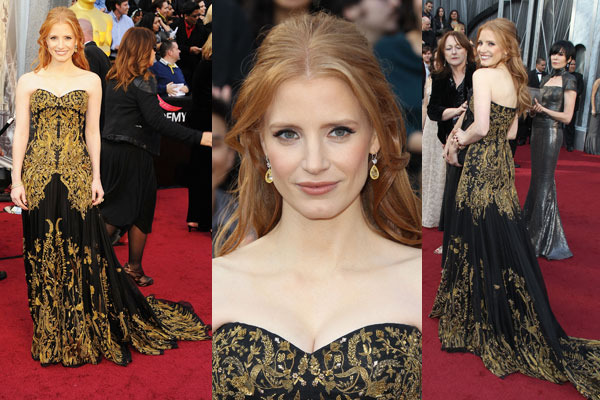
Another actress who stood out from the crowd was Jessica Chastain who stars in The Help.  She wore Alexander McQueen, pictured below.


Jessica's was one of numerous dresses which drew attention to the shoulders.  Strapless and one shoulder dresses were one of the main trends of the night as can be seen below.

                               
   Michelle Williams in Louis Vuitton                           Ellie Kemper in Armani Privé

                                     
           Angelina Jolie in Versace                                Rose Byrne in Vivienne Westwood

                                            
                                            Milla Jovovich in Elie Saab

How do fashion brands such as Versace and Elie Saab, know what is on trend to dress celebrities on the red carpet?  Worth Global Style Network (WGSN) monitors trends through covering trade shows such as Première Vision, collating photographs of runway shows, street fashion and retail stores around the world (Tungate 2008 p.87).  As a result, WGSN has numerous fashion brands as clients.  On the one hand, consumers are regarded as creating the trends through street style and companies such as WGSN feed this information to designers which in turn influences their work.   This is known as trickle up theory (Dillon 2012 p.169). On the other hand, the fashion designers, by displaying their clothing on the red carpet, witness their clothing trickling down to the high street (trickle down theory) (Dillon 2012 pp.28-29). 
 
This Marie Claire article is interesting as it counts down the top 50 Oscar dresses of all time.   For a look back over the history of the Oscars, check out this website which also provides the reader with an insight into red carpet fashion from 1929 to the present day.  

Tuesday, 28 February 2012

Oscars 2012 - The Artist

The Artist was one of the most successful films at the Oscars this year.  It won five awards including best picture and costume design, which some may find surprising considering it is a silent black and white French film.

The Artist is set in Hollywood from 1927 to 1932 which takes us back to the start of Hollywood's golden age which lasted until the late 1950s.  The film focuses on a silent movie actor when such films were on their way out as the 'talkies' made their mark.

Flapper Outfit from The Artist

The costumes from The Artist are now on display as part of the 20th annual Art of Motion Picture Costume Design exhibit at the Fashion Institute of Design and Merchandising (FIDM) in Los Angeles.
The Artist costumes on display at FIDM

Young women, including Hollywood actresses such as Joan Crawford, below,  in "The Roaring Twenties" were often referred to as flappers. They wore loose fitting dresses and girdle bras to minimise their bust and hips in order to appear boyish which was a way of rejecting the previous feminine Victorian style.  This article discusses the fashions of various decades including the 1920s.

Joan Crawford


The modern woman of the 1920s was independent (she had to be when so many men died in World War I) - she drove, smoked with a long cigarette holder, voted (if you were under 30 not until 1928 in Britain), wore heavy make up and her hair short under a cloche hat, had casual sex, she danced to jazz music and drank alcohol (illegally in America due to prohibition).  


In the 1920s, fashion magazines such as Vogue encouraged the flapper outlook by reinforcing the idea that women now had choices:


"Gone is the prim, put-upon female, the old maid of bygone days, and in her place is an independent person who glories in the fact that she doesn't have to marry unless she wants to." (Vogue 1925). 

Vogue also ensured all women had access to the flapper fashion by providing sewing patterns for those who could not afford to buy the garments from stores.
A Vogue cover, 1926

The flapper fashion came to an end with the Wall Street crash of 1929 and the great depression, which followed.  However, the flapper look is a key trend for Spring/Summer 2012:

Gucci flapper dress (Marie Claire)

How does a historical trend come back into style? Designers are inspired by historical fashions but they update the look for the modern consumer.  Laver (1937) argues that fashions change and come around again due to the theory of the 'shifting erogenous zones' in that "different parts of the body are emphasised by veiling one part and unveiling another" (Kim, Fiore and Kim 2011 pp. 16-17).  Essentially, when one part of the female body has been repeatedly exposed the item goes out of fashion to prevent men becoming bored.  However, there has been criticism of this argument, for example, from a feminist perspective by Wilson (1985).  She claims that this is incorrect as any item of clothing may focus on more than one part of the body, she highlights other influences such as Hollywood (such as The Artist making the flapper fashionable again) rather than what men think and that this theory is flawed as it is limited to women's clothing.

Sunday, 26 February 2012

London Fashion Week 2012 - Burberry and Mulberry

Although Burberry and Mulberry are regarded as British heritage brands, young Hollywood movie stars such as Michelle Williams and Kate Bosworth, pictured below, were spotted in the front row of the brands catwalk shows at London Fashion Week Autumn/Winter 2012/13.


Michelle Williams at Mulberry Show, left, and at the after party in a custom made Mulberry dress, right.


Kate Bosworth at Burberry
Burberry and Mulberry are fashion brands which focus their identities primarily on their country of origin, history and heritage.  Mulberry claim to sell "luxury English fashion" whilst Burberry refers to itself as being "an iconic British luxury brand established since 1856."  However, these brands have in recent years reinvented themselves eradicating the traditional British heritage image of stuffiness or chavs, as became the case for Burberry.  They have used a winning combination of Britishness and quirkiness to attract younger consumers as can be seen from these video clips of their shows at London Fashion Week 2012 below.

Sunday, 19 February 2012

Berlin Film Festival 2012

Today was the last day of the Berlin International Film Festival, which is also known as the Berlinale. 

2012 Berlinale Poster

The festival began in 1951, only six years after World War II ended, in an attempt to rejuvenate Germany's cultural scene.  Rebecca, starring Joan Fontaine and directed by Alfred Hitchcock, opened the festival in 1951.  For more information on the beginnings of the Berlinale look here.


                                                   1951 Berlinale Poster                         

                        
Joan Fontaine

Rebecca Film Poster


Back to 2012's festival and for me, the best outfit was Diane Kruger in a glamorous Giambattista Valli Couture 2012 gown pictured below.  Which outfits stood out for the right or wrong reasons at the festival for you? 

Diane Kruger in Giambattisa Valli

Other famous film festivals include Cannes, Venice and Edinburgh.  The Cannes Film Festival states "it has remained faithful to its founding purpose: to draw attention to and raise the profile of films with the aim of contributing towards the development of cinema, boosting the film industry worldwide and celebrating cinema at an international level."  However, Boorstin (1987) describes celebrities as "human pseudo-events" (p.45) who are "known for [their] well-knownness" (p.57).  He explains that pseudo is defined as false or intending to deceive (p.9) and argues that film stars are "figments of the media" whose "chief claim to fame is their fame itself that they are not known for their achievements.  They are notorious for their notoriety" (p.60).  Film stars have then generated other pseudo-events such as the premieres and these festivals.  These are not real life news events worthy of our attention, he argues, but trivial and only spawned in order to create news and for these human pseudo events to be seen.  

Monday, 13 February 2012

Bafta Awards 2012 and Ethical Fashion

The 2012 Bafta Awards took place last night in London.  In terms of the fashion, ethical came out on top! 

Michelle Williams surprised everyone by choosing an H&M dress, which is part of the high street chain's latest conscious collection which is due to hit its stores in April. This is part of the retailer's sustainable initiative.


Michelle Williams in H&M

Colin Firth in Giorgio Armani and Livia Firth in Paul Smith

Livia Firth,  the woman behind the Green Carpet Challenge, wore a suit made from organic wool.  Take a look at Livia's blog here.  She also encouraged her husband Colin Firth, Michael Fassbender and Viola Davis to wear ethical outfits as part of the Green Carpet Challenge.  Colin Firth and Michael Fassbender's tuxedos are made from organic wool and recycled PET bottles.

Michael Fassbender in ethical Giorgio Armani

Viola Davis wearing the first ever ethical Valentino outfit made out of recycled PET bottles

However, do consumers actually care where their clothing comes from?  It has been argued that it has "emerged from the research....that most consumers pay little heed to ethical considerations in their purchase decision-making behaviour." (Carrigan and Attalla 2001 p.574)  However, this was the view in 2001, could it be argued in 2012, that ethics plays an increasing role?  This article argues that the majority (83%) of consumers are interested in ethics when purchasing goods.  Do you consider ethics when purchasing fashion garments?

Sunday, 12 February 2012

World War II and Hollywood

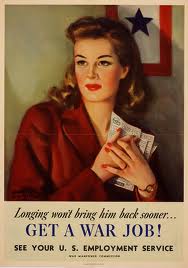
World War II resulted in more women than ever before going out to work.  In December 1941, the conscription of women to work was made legal in the UK due to the National Service Act (No.2), whereas in America, women were encouraged to volunteer by magazines and posters such as the one below.  These posters aimed to overcome the resistance at the thought of women doing traditionally male work with words such as "many factory jobs are very similar to running a sewing machine or vacuum cleaner, assembling a meat grinder, sewing by hand, and other familiar household tasks" (Yesil 2004 p.107).  Moreover, once the war was over, it was "implied that....women would 'gracefully' withdraw from ''men's jobs'". (Yesil 2004 p.103) 

During these difficult times, where utility fashion and rationing were the norm, women looked to Hollywood for fashion and glamour.  For example, there were the pin up stars whose faces and bodies were splashed across posters and films to cheer up the troops while women copied their cosmetics, hair and clothing.  

Betty Grable was one of the most popular pin up girls of WWII

Additionally, Hollywood actresses did their part for the war effort by performing for the troops at the Hollywood Canteen where members of the armed services could go for free refreshments, listen to bands and to socialise with their favourite movies stars.  

Bette Davis at the opening ceremony of the Hollywood Canteen, 1942


Hollywood actresses also embarked upon world tours to entertain the troops often putting their own lives at risk. 
Marlene Dietrich swapping war boots for high heels prior to entertaining the troops

  Marlene Dietrich performing for the troops

Furthermore, the actresses promoted and sold war bonds which the US government issued to fund the war.  Below is a video of Bette Davis informing people they should buy war bonds instead of Christmas presents.


Therefore, women, as well as men, assisted in the war effort.  Hollywood actresses entertained the troops and sold war bonds whereas most women embarked upon traditionally male work but only until men returned home and women would go back to the kitchen.